Saturday, 14 March 2015

No it is NOT Man Hating, Here's Why

Graphic from an article titled "Five Reasons to Teach Feminism in High School"

Hey readers! Long time no see (like over a month... whoops, *sheepish laugh*)  Sorry about that, I've just been really busy, and tbh lazy so I haven't gotten around to doing a new post, but I had some time today so I thought I'd put something up. So without further ado:

No it is NOT man hating. Here's why:

Nowadays topics such as gender inequality, gender-based violence and intimate partner violence seem to be getting more and more attention, and before I say any more, I have to say that is AWESOME. 


Without a doubt it's great, but like many awesome things it does not come without hurdles, in this case, I think the biggest one is that sentiment that keeps on showing up that varies but essentially goes like this: "But what about the MEN?" 

Those who take it even further will even say "xxthing happens to everyone, the fact that you are only concerned about the women PROVES your misandry." 

I'm not saying that misandry does not exist; I'm not saying that men's problems are not important; and I am certainly now saying men are never mistreated, it's just that what you're really doing in making a comparison like that is comparing apple to oranges. 

I'm going to start by looking at that specific
argument and I'll talk about why -- though it seems like it is -- it is actually not logically valid. 

The main thing is, the argument is based on the assumption that men and women are on the same level in society, that men and women hold the same power and can access the same amount of privilege, and that is simply not true. 

(For those of you who might want to better understand the concept of "privilege", you'll find some good stuff here, but essentially what it is is that certain groups have more advantages/certain groups are more disadvantaged in society because of certain things about them.) 


Elena Serova recently became the first Russian Cosmonaut aboard
the ISS and the media asked her about her hair...
Men still hold most of the power in society (it helps that most politicians are men). They tend to be taken more seriously -- when a man does something great, the media doesn't tend to totally disregard that and ask about their hair, and of course there is the infamous wage gap.

Just by being male, males don't have to deal with a lot of things that can hold them back. When have you ever seen anything about politicians trying to impose laws on a man's body?

This is not to say that men don't suffer, they are just privileged with not having to deal with certain things.

So giving more aid to women in an issue that affects both genders is not misandry, because women need that aid to level the playing field and make things fair

Think of it this way. Say there are two towns on
the coast and a tsunami is headed their way. Both villages are the same distance from the shore, but one is a couple hundred metres higher in altitude than the other (this would represent privilege). 

Does sending more aid for the village lower down after the tsunami mean you're mistreating the village higher up? 

No! The village lower down would require extra help to get on its feet compared to the one higher up, since it would be affected more because of its lower position. It's only fair, it's only right to send more help to the village lower down because they need more.

It's the same way with men and women. Women are disadvantaged compared to men, and because women started off disadvantaged, to make things fair, women would have to be given more help with the issue. 

Emma Watson gave a beautiful analogy recently in a conversation with HeForShe, stating that the human race is like a bird and right now, one of its wings is clipped, so we can't fly as high as we're capable of. 
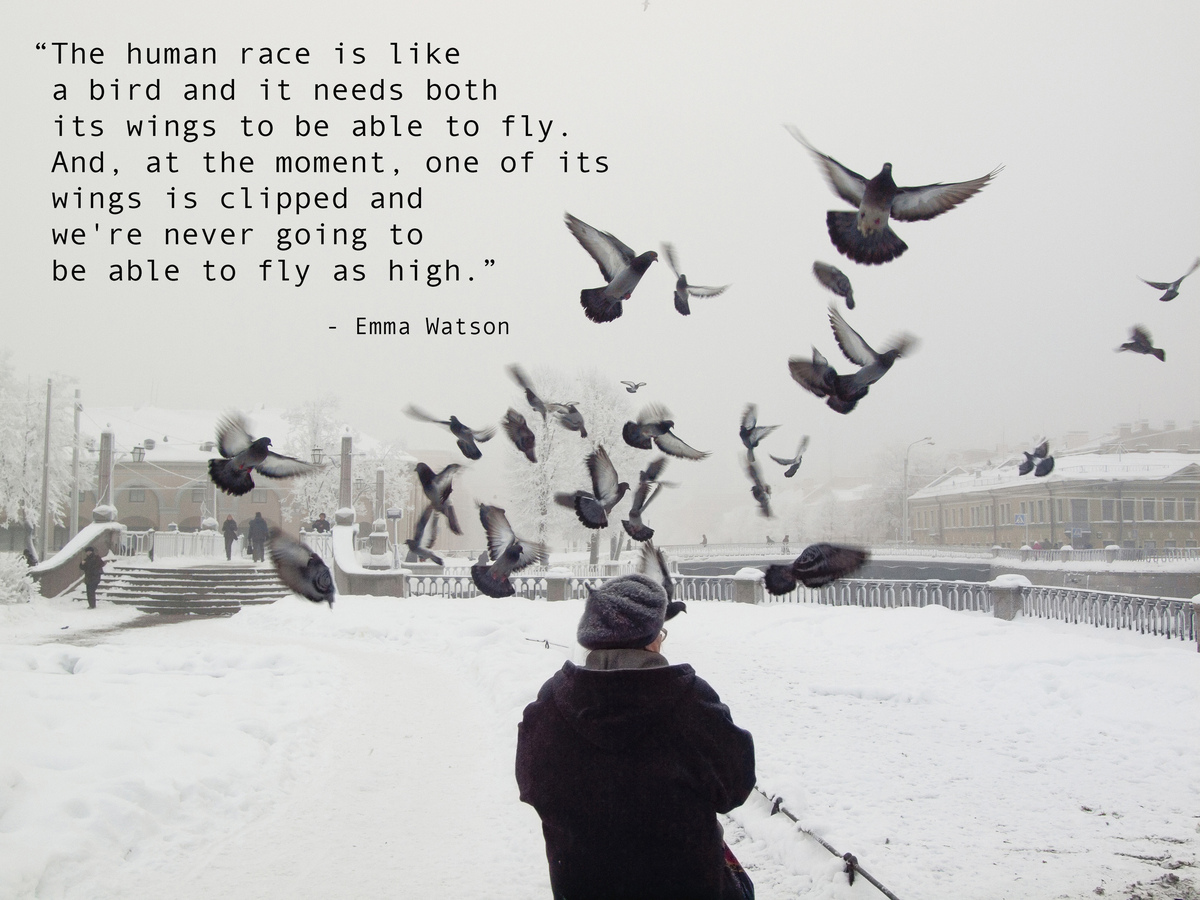

Taken from a Huffington Post Article

Before we can really move ahead and make things better for all people, we need to even things out so women are not disadvantaged by just being women, so women's lives are better, so we can help the human race soar. 

If we keep giving the same amount of support to both sides, we're never going to reach what is fair -- an even playing field -- so though it is unequal to help women out more than men, right now we need that in our journey toward what is right.

Because as I discussed in this post, we don't need equal, we need equitable.  

It's the same the other way around too. For example with the issue of the objectification of women, there are a lot of indignant cries about the fact that men are also objectified. 

This is true, but the objectification of men does not hold the same detrimental effects to men as the objectification of women does to women. 


Here's another analogy to help see why: imagine that a man and a woman are both standing on some sand. They are the same height, but the woman is standing in a hole dug out in the sand. Two mean people come along and one starts kicking sand at the man and the other starts kicking sand at the women, the two people do this at the same speed. 

Who would be buried by sand first? The woman, because she started off partially buried, she started off disadvantaged.

Similarly, with the objectification of women, even though the same thing is being done to both genders, the effects are for worse and far more concerning when it's being done to a woman because women started off with less privilege; and when men objectify women it has a greater effect than when women do so to men because there is that imbalance of power.   

We simply can't say that because something happens to both genders, that not including what happens to the men in the conversation is mistreating them. It just doesn't apply the same way and doesn't incur the same results because of the imbalance of power privilege.


I'll be real, I'm kind of sick of hearing about
women too. All the time it's just a string problems
that women face, but my question is, why have things not changed already? We talk about these issues over and over until they seem overdone, still it's hard to find some concrete evidence of change. 


And when it does happen to both genders it bothers me when they make it seem like it only happens to women

But in the end, you can't forget that things like gender roles contribute to the plights of men and that conversations around violence against women, for example, work to break gender role expectations for BOTH men and women, so though the focus is not on men, these campaigns "for women" are working to make things better for men as well. 



I think just as a society we need to have an understanding that though, in general, women are portrayed more often as the recipients because we are the ones experience these negative things more often, we are not the only victims. We need to understand that the problem is not men, but bad people of ALL genders. 

Please share and hit those g+1 buttons if you like this post and/or my blog. And as always, I'd love to hear your opinions so share them with me in the comments! 

Sunday, 1 February 2015

What Causes Someone to Perceive One Thing When an Entirely Different Thing is Happening?


So originally I had this lined up to be one of the first blog posts, for whatever reason that didn't happen, but here it finally is.

It all started when I read this article titled "I Was Taking Pictures of my Daughters. A Stranger Thought I was Exploiting Them" I've linked the article there for you, but essentially it's the story of an interracial family, a white couple had adopted two girls from China, and at the time the event occurred they were 16 and 17, young women. The father was taking pictures of his girls on the deck of the ferry en route to their annual vacation spot, and they were doing so for a while, trying to get the perfect shot. Then a random man comes by and asks the girls if they are alright. It took them a while to understand, but then they realized that the stranger thought the girls were being exploited and photos were for something not very great. 


It was then revealed that the man works for the Department of Homeland Security. (This is going to be part of something I discuss later)


What to question here is of course the role of race and racial profiling Had they not been an interracial family it's unlikely the man would have perceived the picture taking to be suspicious. 

And for me, it also seems like a good example of the separate/different/other mentality that race, for whatever reason, still evokes. From what I read in the article, it seems like the automatic assumption taken from the presence of different races was that different race = different and cannot equal a group that's together. 


Lately, in my probe into race and what it still means in society today, I've come to realize that it seems to be some kind of insurmountable barrier of difference. 


Race is likely the first thing a person notices about

someone else and yeah it makes sense that there's an initial thought of difference, but it almost seems like to a lot of people, the difference in race almost negates any other similarities. 

It isn't a really prominent in-your-face thing of course, it's more under the surface, manifesting as Microaggressions


For an example I'll turn to the way non-white people in Canada or the US are sometimes told to "go back to where they're from" even though that person might be a 5th generation immigrant who speaks perfect English and the only tie they have with the country their family's from is the way their features look. 

As well, I think it demonstrates how, though supposedly interracial marriages/families are on the risefamilies different from the traditional mother and father of the same race who have a baby together dynamic are still often not perceived as what they are (as in families and not just people  who just happen to be in the same place/people involved in a sinister situation.).


But more than, that I think this situation that befell this interracial family illustrates how broken our trust in our fellow humans are. 


The author of the article wrote a question near the end that has become the title of this post: What causes someone to perceive one thing when an entirely different thing is happening? 

My answer? I think it's simply: because we've been taught to; because we've taught ourselves to. 


We just hear about so many negative things that other people are doing - this person was stabbed today, that person was shot; this conflict has killed XX thousand people, that terrorist group is threatening to do XYZ. We're constantly bombarded by awful news, is it a wonder that we are so suspicious and unable to trust in the benevolence of our fellow humans? 


The world we live in, the way people act and treat others has caused us to be very paranoid and suspicious of others' actions. We feel this need to "protect ourselves" from others. 


A perfect example is something that happened to me over the summer. I met a friendly old man one day when I was out walking around in my neighbourhood and the whole time he was talking to me I kept on thinking, "Oh my gosh what am I doing? What if he's a murderor / pedophile / psychopath / some other type of person that might mean me harm?" 

It turned out one of my friends actually knew him and she assured me he was harmless. Afterward I felt really saddened that the world has made it so the first thing we think when we meet a stranger is that they may harm us. 


And the thing is, I'm just a teenager


I haven't been exposed to as many malicious actions as an adult would have, and what I've seen is definitely nowhere near what the man that worked for the DHS has. Yes, he did not handle the situation very well since he didn't account for the possibility of things not being the way he perceived them to be, but can you really blame him? 


Working in the field he does, he must have see a LOT of people doing terrible things to others, and people in fields like that must have a particularly warped perception of how awful people really are to others (And it really isn't as bad, apparently we might just be in the most peaceful time of human existence) because they see malevolence more frequently and possibly to a greater degree than most people. 


It's like when you first find out about something you hadn't previously known about, all of a sudden you spot it everywhere, even in places where you hadn't realized it was before. Or when you're really familiar with something, you see it really easily. 


We are programmed with a strong will to survive, with that comes with fear for the welfare of ourselves. And, just in general I think we are creatures filled with fear -- we fear the unknown and we fear what may hurt us and those we care about. 

Add in all the terrible things we keep hearing about that other people are doing, that makes us start to fear others, and because we're so bombarded by bad things that are happening, I think that's led our brains to constantly make connections to the malicious when (at least I hope ) most of the time what's happening is actually benign. 


And if we take it a step further, maybe we even fear ourselves, because we ask "Well what's the difference between me and that person doing terrible things? Could I do terrible things like that?" and the lack of a biological difference that would render it impossible for you to be as awful as "them" might disquiet you. 


Of course, most people don't like to feel that way, most people would rather the problem be solely outside of them, most people want something or someone to blame. That way, you can get a weapon, take self defense or whatever and "protect yourself". It's a heck of a lot easier than grappling with the darkness inside of you, than explore your deepest darkest parts.   


So in addition to our already uneasy feelings toward others, we might try to project our own darkness onto others. 


However, I think it's important to try and figure

yourself out, because it's only then that you can change yourself for the better. If you recognize you are probably capable of doing awful things you'll realize something you might consider doing as awful BEFORE you do it so you can prevent it from happening. 

If we want society to be better, we need parts - people - that are as good as they can be. 

So moral of the story, things aren't always as they seem to be, check your biases and if you choose to do a great thing and try not to be a bystander, just try to be sensitive and approach things in a way that allow you to be wrong while causing minimal damage. Recognize that we are all human, for better and for worse, but you don't have to let the worse define you. 


As always, please hit those g+1 buttons if you like this post (hit the one at the bottom of the post)/blog (hit the one at the very top of the page), and I'd love to hear people's opinions on this, please share them with me in the comments. 

As well a quick Poll: Do people prefer long posts like this one or shorter ones such as the few I put up before this one? Or should I have a mix of both? Tell me that in the comments too. :) 

- Maggs 


Tuesday, 27 January 2015

“Slap Her": Children's Reactions

    
So this is a really nice, (though not without flaws) social experiment conducted in Italy that I think serves to open up the conversation about males being socialized to be violent.


Not a single one of the boys here was willing to slap her, so where and why does the problem of males acting violent toward women start? (And yes it is still a prevalent issue, and you can find proof here, and here, and if you google it you'll find thousands more) 

In all honesty it was much nicer to see responses like "I'm against violence" that did not mention gender as opposed to "you shouldn't hit a girl" or "I can't hit her because she's pretty", because while the 2nd and 3rd examples represent something good in that these boys are expressing that they are against being violent toward females, it doesn't represent being against being violent at all

The last example also represents how indoctrinated in society the idea of assigning value to females based on their looks is, which is total BS. 


It's really cool that these boys are against hitting the girl, it really is, but in order for violence to stop being such a big issue we need to teach young people to not be violent for the right reasons, namely because it harms the other person and we should be empathetic toward those around us. I think it's only when we teach people to think a little more about how things will affect others that we're going to get concrete results in trying to make sure people stop hurting other people so much. 


And before anyone calls misandry, (and I do have a post lined up addressing this, so be on the lookout for that!) my next point is that I think it's important that we teach all kids to not be violent at all and not just to not be violent toward a group. Violence against women is a more prevalent issue, but I don't think the latter method is going to do much to help society, we shouldn't give off the impression that we think male-male violence is okay, because that isn't either.

So one final thing I want to mention: someone in the comments section of where I first found this video brought up a point that I think is really important to note: all the boys were okay with reaching out to touch Martina without asking if she was okay with it. 


That speaks a lot to what our societies teach kids about consent, which is namely not much. There is no doubt a lot of importance in teaching kids to be non-violent, but we also need kids to know that you shouldn't go about invading people's space whenever you feel like/without knowing that they'd be okay with it; that women are not there for guys to touch and do whatever they please with. 


Well what do you know, this one turned out kinda legit blog-y post like, consider it a thing to tide you over until the next time I dig deep into an issue. :)


Once again, I'd love to know people's opinions on this, so please share them with me in the comments. 


As always, please hit that g+1 button at the bottom of the post if you liked this, and if you like my blog please press the g+1 button at the very top of the page.


Thanks!


Love,


Maggs :)


Friday, 23 January 2015

Another Inspiring, Must-Watch Speech from Emma Watson

Emma Watson is honestly making me love her so much. This is her speech for HeForShe IMPACT 10x10x10 Program at the World Economic Forum 2015

   
She makes a small joke about it in this speech, but she truly writes such great speeches and delivers them in such a passionate, moving way. 

For those of you who are regular readers of my blog: first thank you, it's really cool that you would take your time to read the stuff I write about. Second, the end of the semester has kept me uber busy, so sorry about putting zero things up. And I know this isn't very much either, but it's (sort of?) something to tide you over right? 

Rest assured I have a lot of things planned, I just don't really have the time right now. 

Look out for something on Tuesday though! I'll be finished my exams and should have a lot more time. 

Stay Awesome!

- Maggs :)

Friday, 9 January 2015

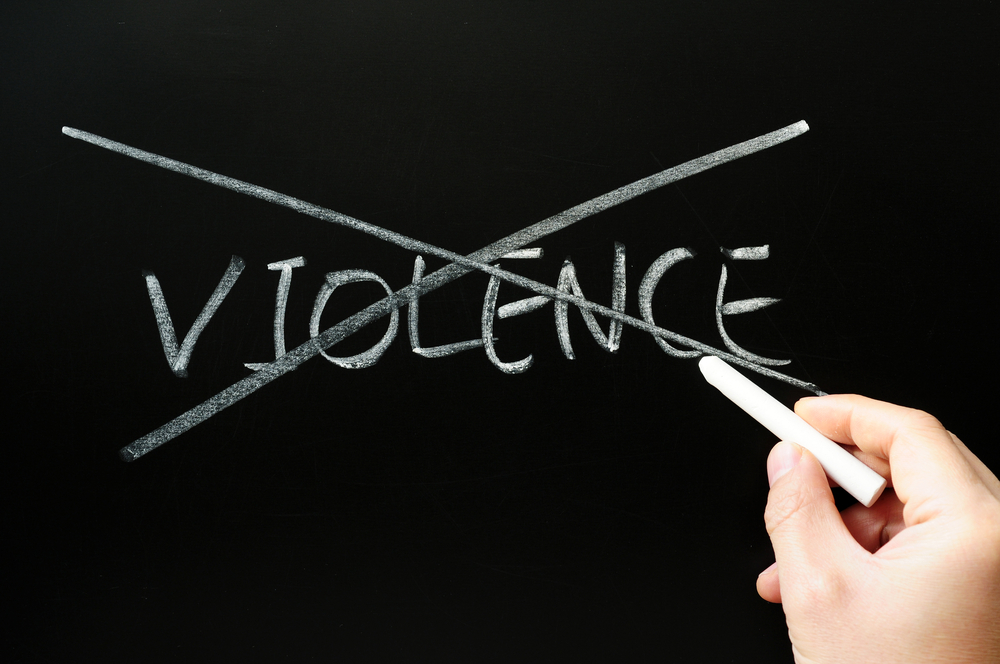
You Don't Agree with Someone? That's Totally Fine, but Here's What to NOT do About it


I thought this was an appropriate post to put up today considering everything that's been happening in France, primarily Paris, lately.

The world is outraged, horrified, and saddened by these tragic events, and before I go into the main idea of this post I thought I'd do my part in stopping the spread of Islamophobia in it's tracks. 

The actions of these extremists SHOULD NOT IN ANY WAY be taken to reflect the beliefs and ideologies of all Muslims. These individuals are extremists, they, quite frankly, use religion as an excuse to do awful things. (Or at least delude themselves into thinking what they're doing is right because of religion). It is illogical and unfair to tie the general Muslim population to extremists. 

Ahmed Merabet, The Muslim police officer that was killed
In fact, one of the officers killed on Wednesday was Muslim, he died protecting Charlie Hebdo's right to free speech. If you haven't already, I encourage you to look deeper into the double standards, and additional perspectives that mainstream media might not be providing.

Onto the body of the post:

Originally, this post was to come right after the Good Drowned out by Bad Post (And it'd still probably be of use to read that one before reading this one), but things changed. 

Let me begin by saying that people deciding it's okay to threaten somebody over exercising their right to freedom of expression is something that bothers me to no end. 

First off, it's seriously not cool to threaten someone period. 

Second, there is a person on the receiving end, a person who has feelings just like you, and your threat, whether you meant it or not, can make them feel unsafe, and EVERYONE is entitled to feeling safe.

It just makes absolutely makes no sense. Somebody expresses themselves, and maybe it hurt your pride, maybe it offended you, but are those grounds to threaten that person's well-being? 

To me at least, it seems like doing so is just WAY overcompensating for the harm that was inflicted on you. 

Because it's not like it's threats such as "I will slap you" It's things like "I'll kill you", "I'll rape you" (particularly common when directed at a woman) and "I hope you get Ebola". 

For me, this seems to show either calculated malice, or ignorant insensitivity (or both). 

And I've seen all of these threats made myself. The Ebola one was during a time where the Ebola outbreak was a really big thing, and it was directed toward Taylor Swift on a commercial she'd done for Diet Coke. 


The person said they hated Taylor, and wished the disease upon her. First off, how do you hate someone you have likely never met? Why would you bother to hate someone you don't know?

Second, I think it's a pretty good example of a very troubling trend with these threats. 

There will always be the generic "I will kill you", but it's things like "I will rape you" and "I will post personal photos of you" that really bother me, because regardless if they are empty threats, it displays a level of thought and deliberation on how to violate the person so that they feel as awful as possible.

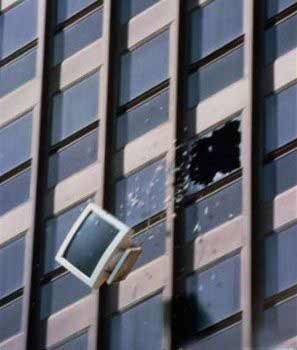
Morals should not end up like this monitor
We need to move away from that, we need to stop being so negative and hateful. Yeah people's opinions can be misinformed and awful, yeah they can mean change and that can be scary, but we shouldn't be willing to throw morals out the window because somebody said something. 

And even if the person making the threat doesn't mean to go through with it, it could inspire somebody that would go through with it. 
  
Words might not be able to do much by themselves, but they can serve as ignition for scary things - after all, it was words that started and allowed some of the worst events in human history to happen.

"Yes we all have the right to an opinion, and freedom of expression and they're great things, but we don't always have to use them."
  
Many of those threats are made thoughtlessly on the internet, and that's one sucky thing about the web, what happens there seems less "real", so doing something online doesn't seem like a big deal. (rhyming unintended ;))

But the fact of the matter is that it is. It means
people feel the need to leave their homes, and if people go through with the threats, it means people are hurt. 

There are appropriate ways to express dissatisfaction with an opinion, and threatening the person that holds that opinion is NOT on of them. 

So people if we could all please just take a moment and consider what we're doing before we say/post/tweet/text etc. something? And this I mean to apply to all scenarios. Because so many hurt feelings and hurt feelings that lead to awful events can so easily be avoided. 

And this is not to say I'm cool with people expressing harmful, violent opinions. Yes we all have the right to an opinion, and freedom of expression and they're great things, but we don't always have to use them. Nobody is forcing you to speak your opinions, and if it's not going to do any good expressing it, then maybe you should consider not expressing it at all.

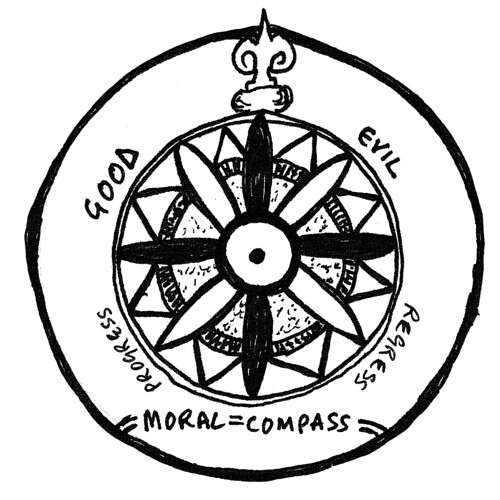
At the end of the day, we need to make sure it's our moral compass that guides us, not anything else, because only then can everyone live a better life. 


If you liked this post, please hit that g+1 button at the bottom. If you like my blog in general, please hit that g+1 button at the very top of the page. 

I'd love to hear what you people think, so share your opinions with me in the comments! :) 

Just a heads up, exams are coming up and I'm not going to be able to guarantee the usual post a week for the next bit. I might share some pictures or songs or something, but legit blog-y posts might take a while. 

Until next time!
- Maggs :)
  

Wednesday, 31 December 2014

Racism And Gender Roles in our Everyday Lives + Reasons for Being a Bystander (Crazy Bus Story Part II)


So this (very late) post (I'm sorry!) is going to explore motivations and influences - what may have influenced each person who was involved in the fight, what influenced me etc. (This is part II of Crazy Bus Story, find part I here )

Please note, I know very little about the people involved, there are so many factors that I have no access too - maybe "Bob" was having a bad day and would have reacted differently on another day etc.. So this is a look at things without the full picture. 

Race: 

When I talked to people about what had happened, some people were certain race played a role. I also definitively feel it was a factor. 


Would Bob have treated Bluebag with more courtesy had he been white? Would Bob have been made as angry by a white kid spitting in his direction? And here's something to ponder, what might the situation have turned into had BlueBag been Eastern Asian? 

Gender Roles:

I have to say that fight was some of the most stereotypical male behaviour I have ever come across. So I mention gender roles because I couldn't help but wonder if things would have ended up differently if there aren't so many voices telling males, especially young males, to be macho and violent. 

And really, the fact that "Bob" was the one that started the fight really surprised me. And I can't say if it was just him or if he wouldn't have acted so violently if gender roles weren't so big. 

I don't know if you noticed, but no women were
involved at all. The bus driver was male, Bluebag and Bob were male, the person that ended up stepping in was male. And it's not like there weren't many women on the bus, I'd say it was about half-half, there might even have been more women than men.

With gender roles we question what came first? Did how men and women act precede the expectation of how men and women act, or do men and women act the way they are expected to?

Is the difference between the way men and women act due to nature, or do we conform because that's what we're taught to be and we believe that's how we naturally are? 
  
As A Bystander: 


I can't speak for everyone who didn't act, but here were my reasons. I did absolutely nothing, and I felt awful about it, I'm taking a course called genocide and the whole thing is about "You gotta do something, you gotta do something" Yet I still didn't do a thing. 

Why was that?

Well... I was definitely afraid for myself, BlueBag was oozing aggression and this... sort of flippant disregard for others and for himself for that matter. So yeah there was some fear of him, of maybe becoming the focus of aggression if I did something. 

Though I want to be very clear I was NEVER fearful for my personal safety, never thought I'd be hurt. Me being the shy person I am, I did feel anxiety at the idea of speaking up - I guess that's another factor, the person's personality. 

Second, there was the fear of exacerbating the situation. Especially at the beginning, it didn't seem like it would be a big deal, and maybe it just seemed like the risk of making things worse was greater than the chance of making things better. 

Looking back on the situation that fear seems pretty legitimate. if several people had intervened, if I had been in BlueBag's shoes, I'd have felt ganged up on and that's never a good situation to create. 

I think the biggest thing that kept me from acting though, and this ties in with sexism and the Kyriarchy, was that I didn't feel like they'd listen to me. 

As a teenaged, Asian, female, I didn't feel like
Powerless ;)
these two men would take me seriously. In this case, I don't think the fact that I'm Asian would have played a big role. Mostly I thought they'd look at me and think "Pff, what does this kid know? Why should we listen to her?" paired with a "I don't take women seriously" sentiment as that's a pretty big thing in our society. 


While it was happening I felt very acutely how (and maybe this is just a perception of mine) women and young people's opinions aren't really valued, and that really weighed me down. 

Additional Points of View on Reasons For Being a Bystander: 


  • When I discussed what happened with the friend that had witnessed the event with me, she expressed another sentiment that was probably widely held by the people on the bus: "You didn't feel like it was your place to intervene".
  • Talking to another friend about what had happened, when I mentioned how I hadn't done anything, her reaction was "You don't want to get involved". This kind of ties in with my first point, there's chance that intervening would come back to bite you in the butt. 

Yelling to the Bus Driver: 


Authority Figure
The last thing I want to discuss is the way both Bluebag and Bob were yelling at the bus driver to control the other person.

I don't know how well I can describe why, but I just find the scenario really... curious. 

I guess it's just something about how they were both grown men, very capable of making their own decisions and resolving their own disputes, but the first thing they do is try to get someone else to make the other behave. It was just very reminiscent of children on the playground needing a teacher to settle the dispute

I guess since it happened on the bus, the bus driver counts as an authority figure, and if you've ever heard about The Milgram Experiment people are very inclined to obey an authority figure. 

This was kind of seeing that in action, not of how people tend to listen to an authority figure, but how people naturally default to an authority figure to try to make someone else listen. I think it's really interesting that it happens that way, not only do we tend to be obedient to authority, but we also know that people tend to listen to authority, without necessarily explicitly being told about it.

If you liked this post it would be amazing if you
Looks like this!
clicked that g+1 button at the bottom of the post, it recommends this post, which will boost my rep on google.


If you like my blog in general please be awesome and click the g+1 button at the top of the page, that's for recommending my blog in general. Please and thank you. it actually really helps.  


Sunday, 21 December 2014

I Couldn't Help but Wonder What Role Race had to Play + The Bystander Effect in Action (Crazy Bus Story Part I)


So this is an absolutely true story - it literally happened on Friday around 1:30 pm.

Me and a friend had gotten on the bus, happy to be done with school for a bit, excited to go home and not have to do anything.

A couple of stops in we realize the bus driver was arguing with some guy that just got on, I'll Call him BlueBag, and I remember being curious about what happened, but then the guy walked into the bus, and though he muttered something along the lines of  "shut the fu** up" it seemed like the thing would just blow over.

About a minute later we find out what BlueBag and the bus driver had likely been arguing about - he'd just spit on the bus.

So another guy, I'll call him Bob, who was sitting pretty close to where BlueBag was standing starts talking to him, none too nicely, might I add. Bob was saying things like "Stop it. You're fu**ing ignorant, you're so fu**ing ignorant". In return BlueBag answered with things like "I don't fu**ing care. Why don't you make me [stop spitting]?". BlueBag was being aggressive about it, walking over to Bob's seat, and because of the way the seat is placed and how he angled himself Bob was pretty much cornered in.

I didn't quite see what exactly happened, but then BlueBag was saying things like "You put your hands on me? Don't put your hands on me. Do it again and I'll take care of you." so I assume Bob had pushed him away or put his hands on BlueBag's shoulders/arms.

Bob yells to the bus driver about telling BlueBag to stop spitting, Bluebag starts yelling at the bus driver to tell Bob to not touch him. (And I find this part very interesting, I'll elaborate later, so keep it in mind)

So the bus stops and the Driver asks Bob whether he feels like a call should be made (I'm not quite sure to what, but I assume to some sort of security enforcement or even the police). And Bob goes "No, no whatever"

And once again I thought things were going to be fine.

I couldn't have been more wrong.

The bus driver was getting ready to continue driving, but then BlueBag, turns toward Bob and if he didn't legitimately send his saliva in Bob's direction, then he made the gesture.

After that it got crazy.

Bob was absolutely enraged by the gesture. He
surged up from his seat like a tidal wave or tsunami or something and just bashed Bluebag, without holding back. Then he got up from his seat and the two men were full on fighting. 

They were punching each other, throwing themselves at the other guy etc. At one point one guy overshot where he'd meant to throw himself and ended up flipping.

They traveled a good 3 meters from where they were standing up toward the front of the bus, and somehow Bluebag got shoved off the bus (the bus' front doors had been open). 

Right after that, is one of those moments of solid clarity that you get sometimes, Bob had been wearing earphones, the earphones caught on something and I just remember Bob yanking them back toward him abruptly and angrily, they snapped back toward him, the two earpieces flying apart before coming back together.

All I could think was "Oh my God, somebody could have choked."

At this point a third man steps in, putting himself in the doorway of the bus' front doors, I couldn't hear what he said, but he seemed to be trying to placate the two. He even got off the bus and seemed to be planning to accompany BlueBag somewhere, or maybe he was trying to make sure BlueBag stayed put.

Nothing happened for a bit, and then everyone was told to get off the bus and get on the next one. As we were getting off, we noticed that out of nowhere some sort of vehicle right in front of the bus - it was striped like a police car, but had no lights at the top.

So where does Race come in? Well what if I told
you Bluebag was a Person of Colour - a young man that was maybe 20. Bob, was a white fellow, probably in his fourties - his hair was grey. And the good Samaritan that intervened was another white man - maybe 25.

And I know the chance of these actual men seeing this is slim to none, but this also goes out to anyone who can relate.

First off: Bluebag I understand. Life is tough, yours is probably tougher than a lot of other people's and you're angry about it. And I really hate that life would make it so you are that angry, but spitting in the bus, antagonizing people and being rude is not an acceptable way to deal with anger.

Bob: Thank you for trying to do a good thing by trying to keep the bus clean, but in truth being condescending and swearing at BlueBag etc was probably the exact wrong thing to do. When someone is doing something you don't like and you want them to stop, usually the best course of action is to be assertive, but polite, for example saying something along the lines of "I don't like that, nobody likes that please stop"

This was the most prominent case of the bystander effect that I have ever experienced. There were maybe 20 people on that bus. We could all tell that BlueBag and Bob were not happy with each other and showing signs of aggression. Nobody really did anything until that third guy stepped in, and even that took a while. 

So to the third guy that decided to intervene: thank you for stepping in and doing something when nobody else did.

Stay tuned, because in the next few days I'll have a post up exploring what happened and factors that may have been involved